Hi makers! Welcome back to my new post of RenderWrench 3d printing series. Hope you are doing great! In the previous post, we discussed FDM vs SLA vs SLS. In this post we will discuss a very important aspect of 3D printing (PLA vs ABS vs PETG). Using the wrong filament can cause warping, cracks, weak layers, or failed prints. Here you will learn pros and cons of three most popular filaments used in 3d printing industry (PLA, ABS & PETG), And their areas of usage.
Why Choosing the right filament Matters?
Choosing the right filament for your prints is very crucial and its completely depends on what will be the application of that particular printed part. Wrong material choice may cause your print to fail. And one should be very cautious while choosing material for their print. But we are the smart ones — we will learn and then decide, “what is the best filament for our 3D prints?” So let’s start with some essentials.
Filament Affects Strength
See, every filament has its own capacity in terms of strength. If you are printing a decorative part that just rests on your desk, it’s okay to print it with low-strength materials like PLA. It will save the cost of the print. But if you want a functional part that will undergo some static or dynamic load, you must use PETG.
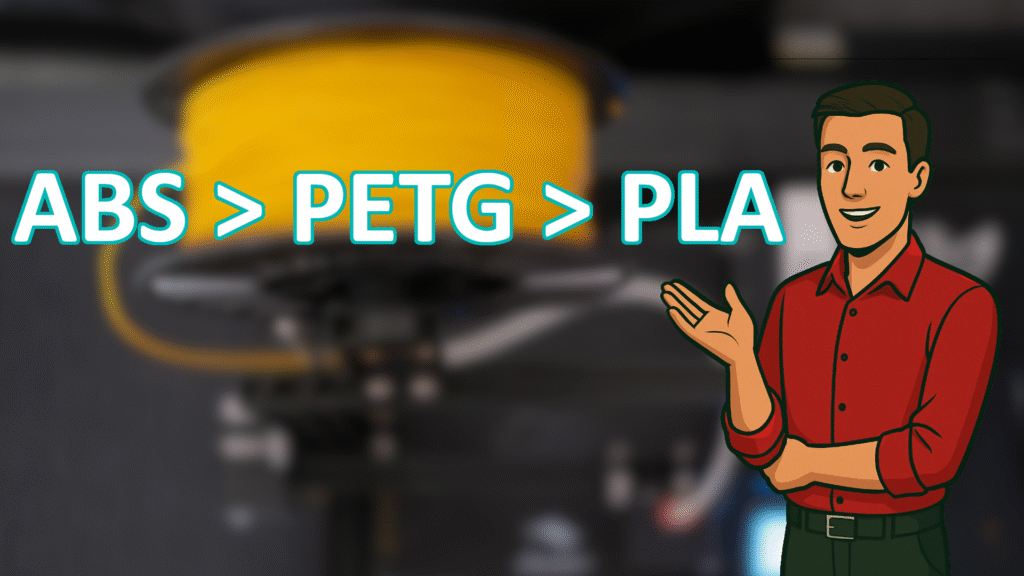
For example, I always use PETG or ABS while print gears as it’s always under dynamic load. And believe me it’s noticeably increased lifespan of my 3D printed gears.
Filament Affects Heat Resistance
PLA, ABS, and PETG all have different temperature resistance. Among them, PLA has the lowest melting temperature. It starts softening around 60°C. PLA can even deform under sunlight. In comparison to PLA, ABS and PETG can withstand higher temperatures. ABS has the highest heat resistance among the three.
For example, if you design an electronics enclosure for outdoor applications, you should use PETG, as it has the best environmental and heat resistance.
Filament Affects Printability
In the 3D printing community, most journeys start with PLA. Why PLA? Because PLA is the easiest to print and very beginner-friendly. When you move up to PETG, it comes with warping and stringing issues. And ABS requires much higher temperatures to print.
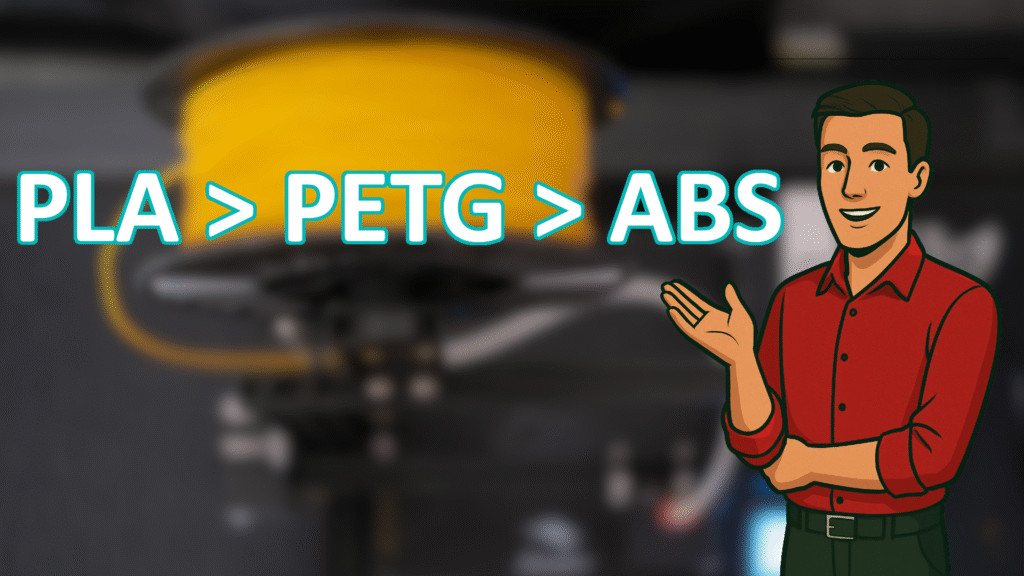
When I tried to print the same parts in PLA and PETG, the PLA part printed easily, but with PETG it started stringing and required post-processing to make it work.
Filaments affects Durability
If you want a really durable part to use outdoors or to mount on a vehicle or similar applications, You must go for PETG. Because PLA is a soft material, it is good for indoor decorative use, and it breaks easily under load. And if you go with ABS, it is very good in terms of strength, but it absorbs moisture and gets weak over time. The best option is PETG.
A few years ago, I built a Raspberry Pi camera surveillance bot. Most of its operations were outdoors. I printed some of it’s part in PETG and Some with ABS. Within a few weeks, I needed to replace all the ABS parts with PETG as they got damaged due to outdoor exposure.
Now we know some important aspects of choosing the right filament for our 3D prints.
Choosing the right filament is not just about color — it decides the strength, durability, and success rate of your 3D prints. In next section we will discuss material properties of PLA, ABS and PETG and learn their Pros ans Cons and their usages.
PLA — The Beginner’s Best Friend
What is PLA?
PLA (Polylactic Acid) is the most commonly used filament in the 3D-printing world. It’s made from renewable sources like corn starch and sugarcane, which makes it eco-friendly and easy to print. If you’re new to 3D printing, PLA is usually the first filament you’ll ever use — and for good reason.
Properties of PLA
- Low warp – prints stay flat without lifting from the bed
- Very easy to print – works on almost any 3D printer
- Good surface finish – clean and smooth results
- Low heat resistance – starts softening around 55–60°C
- Brittle – breaks under sudden load
Pros
- Easiest filament to use
- Very cheap and widely available
- Excellent for quick prototypes
- Great for detailed parts and models
- Minimal fumes
Cons
- Poor heat resistance
- Brittle under sudden force
- Not suitable for high-load, functional parts
- Not recommended for outdoor use
Best For
- DIY decorative projects
- Models and miniatures
- Educational prints
- Non-load-bearing parts
- Quick prototyping
“PLA is where every maker starts — simple, forgiving, and clean.”
ABS — Strong But Temperamental
What is ABS?
ABS (Acrylonitrile Butadiene Styrene) is one of the strongest consumer-grade filaments. It’s tough, durable, and the same plastic used to make LEGO bricks. However — it’s not beginner-friendly. ABS requires higher temperatures, controlled environments, and generates fumes.
Properties of ABS
- High heat resistance – perfect for outdoor or mechanical use
- Very strong and shock-resistant
- Warps easily – needs an enclosure for stable printing
- Strong odor – requires good ventilation
- Can be smoothed using acetone vapor for a glossy finish
Pros
- Strong and durable
- Excellent heat resistance
- Industrial-grade mechanical properties
- Can be post-processed (acetone smoothing, sanding, painting)
Cons
- Harder to print than PLA or PETG
- High warping tendency
- Requires enclosure and ventilation
- Not ideal for beginners
With cons I also Come with fixes, you can check them here- click here
Best For
- Functional mechanical parts
- Enclosures that face heat
- Automotive prototypes
- Robotics housings
- Tools or high-strength parts
“If your part needs heat resistance and toughness, ABS is ready — if you’re ready to handle the printing challenges.”
PETG — The Perfect Middle Ground
What is PETG?
PETG (Polyethylene Terephthalate Glycol) is the perfect balance between PLA and ABS. It prints almost as easily as PLA but has the strength and durability close to ABS. PETG is flexible enough to absorb impact and strong enough for functional parts — making it a favorite among engineers and makers.
Properties of PETG
- Tough and impact-resistant
- Slight flexibility – resists cracking
- Great layer adhesion
- Slight stringing – needs tuned retraction settings
- Better heat resistance than PLA
Pros
- Strong + flexible (best of both worlds)
- Excellent chemical resistance
- Better durability than PLA
- Good for functional parts
- Suitable for outdoor usage
Cons
- Can string if settings are not tuned
- Sensitive to cooling
- Surface finish not as smooth as PLA (slightly glossy)
Best For
- Mechanical parts
- Drone components
- Outdoor enclosures
- Robotics brackets
- Load-bearing prototypes
“PETG is the engineer’s choice — stronger than PLA, easier than ABS.”
| Filament | Strength | Flexibility | Heat Resistance | Print Difficulty | Best Use |
|---|---|---|---|---|---|
| PLA | ⭐⭐⭐ | Low | Low | Very Easy | Models, prototypes |
| ABS | ⭐⭐⭐⭐ | Medium | High | Hard | Functional parts |
| PETG | ⭐⭐⭐⭐ | High | Medium | Medium | Engineering parts |
Which filament should you choose?
See makers! Now you know about the filaments, their properties, pros, and cons. But understanding all this at once may feel overwhelming. So here is a simple guide to help you decide quickly.
- Just started 3d printing? – Go for PLA
- your design needs more strength and heat resistance? – Go for ABS
- You want a strong, durable, mechanical part? – Go for PETG.
- Need parts for Outdoor usage? – PETG is your thing.
- Decorative prints? – Again PLA.
Hope you got the point! Still have questions? Go through the section again or ask me in the comments. I’ll be happy to help you out.
My experience?
I also started 3D printing with PLA. My first prints were drone parts. And it went quite well. Later, after changing my job, I started printing robot parts with PETG. PETG may come with a little beginner struggle, but once you figure out where you need to improve—whether in your design approach or printing settings— You will good to go.
Here are some snaps form the past.
So, makers hope you learned form this post. More post of RenderWrench 3D printing series coming soon. Till then, you can follow me on Instagram to get updates on every post and insights. Happy making!!
FAQ
1. Which filament is the strongest — PLA, ABS, or PETG?
PETG is the strongest in real-world usage, because it has great layer adhesion, flexibility, and impact resistance.
ABS is strong too but becomes brittle over time due to moisture absorption.
PLA is the weakest because it snaps easily and becomes soft under heat.
2. Which filament is best for beginners?
PLA is the best choice for beginners because it prints easily, has minimal warping, and works on almost any 3D printer without special settings.
3. Which filament is best for outdoor use?
PETG is ideal for outdoor use.
It resists UV light, heat, and moisture better than PLA and ABS.
PLA melts in sunlight, and ABS becomes weak when exposed to humidity outdoors.
4. Is ABS better than PLA?
Not always.
ABS is tougher and heat-resistant, but PLA is easier to print and better for details.
Choose based on your project:
- PLA → models, decorative items, low-stress parts
- ABS → functional parts, automotive-use, enclosures
5. Does PETG warp like ABS?
PETG warps less than ABS, but more than PLA.
With proper bed temperature and cooling settings, PETG prints very successfully.
6. Which filament is best for gears, brackets, and mechanical parts?
PETG or ABS.
PLA gears crack easily due to brittleness.
PETG is best because of its:
- impact resistance
- toughness
- excellent layer adhesion
7. Is PLA food safe?
Pure PLA is technically food safe, but:
- color pigments
- nozzles
- bacteria in layer lines
make prints not safe for actual food use unless post-processed.
8. Which filament lasts the longest?
PETG lasts the longest in most conditions.
PLA degrades in heat, and ABS absorbs moisture and weakens outdoors.
9. Why does ABS smell while printing?
ABS releases styrene fumes when heated.
Always print ABS in:
- a well-ventilated room
- or an enclosed printer with filtration
10. What is the best filament for detailed prints?
PLA gives the best detail and surface finish, especially for small models, miniatures, and prototypes.
11. What is the best all-rounder filament for makers?
PETG — no question.
It is the perfect balance between strength, flexibility, print-ability, and durability.
12. what are the 8 Things to Check Before Starting a 3D print?
Click here to find out – 8 Things to Check Before Starting a 3D print