
Hi maker! This is the part 2 of “Compound Gear Trains & Planetary Systems — When and Why to Use Them | Part 1”. In previous post we discussed,
- Compound Gear trains.
- How compound gear trains multiply torque?
- And some related formulas.
Now in this post we will learn about planetary gear trains. Planetary gears can offer many advantages over other types of gear trains. So the big questions is…
“What if we need very high torque in very little space?”
After this post I will make a Gear Calculator tool, and I hope that will make planetary gear box design little easier. To get updates on that follow RenderWrench on Instagram.
So lets, continue with the today’s topic “planetary gear system”.
What is a Planetary Gear System?
A planetary Gear system is a compact gear arrangement where multiple gears rotates around a central Gear, just like planets orbiting the sun.
And the terminology related to Planetary Gear system is similar to the solar system. The middle one is called Sun, Gears rotating around it is called planet gears and the outer gear with internal teeth is called Ring gear.
- Sun gear – The Center Gear.
- Planet Gear – Gear that rotate around the Sun gear.
- Planet carrier – Hold the planet gears.
- Ring Gear – Outer gear with internal teeth.
Unlike other gear system like Simple Gear and Compound gear, in Planetary gear system multiple gears shared same load at same time. This is the key to their strength.
Here is the key point to remember about Planetary gear system.
- Sun Gear – Drives.
- Planets Gears – Shares the load.
- Ring gears – Contains everything.
- Carrier – Delivers the load.
Why Planetary Gears are so Powerful
Before jumping into formulas or configurations, you need a mindset shift to understand why planetary gear systems are so effective.
In a compound gear train, torque is transferred through one meshing tooth pair at a time. The load passes from gear to gear in stages, and each gear tooth individually takes the stress. But in a planetary gear system, things work very differently.
Here, multiple planet gears mesh with the sun gear at the same time. All these planet gears share the load together, instead of a single tooth pair doing all the work.
That single difference changes everything.
What does this mean in practice?
Because the load is shared across multiple planet gears:
- Torque capacity increases significantly
- Stress on individual gear teeth is reduced
- Smaller gears can handle higher loads
- Wear is evenly distributed
- Gear life increases
In simple words:
👉 Planetary gears are stronger, more compact, and more durable than traditional gear trains for the same power level.
Why industry loves planetary gear systems
This is exactly why planetary gear systems dominate applications where space is limited but torque demand is high, such as:
- Automatic transmissions
- EV drivetrains
- Servo motors
- Robotic joints
- Compact industrial gearboxes
Whenever engineers need high torque in a small package, planetary gears are usually the first choice.
Now that you understand why planetary gears are so powerful, let’s move on to the next step and break down how a planetary gear train is actually constructed and how it works.
How Planetary Gear Systems Work
Let’s keep this intuitive first. No formulas yet. A planetary gear system works on a simple but powerful idea:
You lock one part, drive one part, and take output from the third.
That’s it.
Every planetary gear system always has three main components:
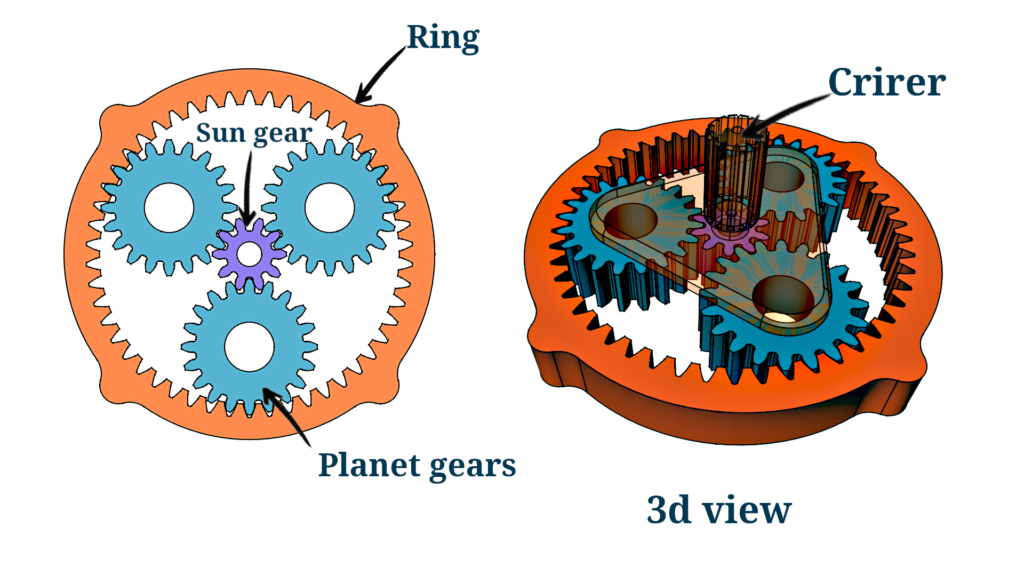
- Sun gear – the gear at the center.
- Planet gears + carrier – gears that orbit the sun and hold together on a carrier.
- Ring gear – the outer gear with internal teeth.
Even though there are three main parts, only one is used as the output at a time.
By choosing which part you lock, which part you drive, and which part you take output from, you completely change how the system behaves.
Same gears. Same size.Totally different results.
Common Planetary Gear Configurations
Let’s look at the most commonly used configurations — the ones you’ll see in real machines.
1. Sun Gear Input → Carrier Output → Ring Gear Fixed
This is the most common planetary configuration.
- Motor drives the sun gear
- Ring gear is locked
- Output is taken from the carrier
What happens?
- Speed is reduced
- Torque is multiplied
- System becomes very compact and strong
👉 This setup is widely used where high torque in small space is required.
Where you’ll see it:
- Gearboxes
- Robotics joints
- Servo motors
- Industrial reducers
2. Sun Gear Input → Ring Gear Output → Carrier Fixed
Here, the carrier is locked, and the output comes from the ring gear.
What happens?
- You get a different speed ratio
- Direction and reduction depend on gear sizes
- Often used for multi-speed systems
👉 This configuration is commonly used inside automatic transmissions, where different gear ratios are selected by locking different gear elements.
3. Carrier Input → Sun Gear Output → Ring Gear Fixed
This one behaves very differently.
- Carrier is driven
- Ring gear is fixed
- Output is taken from the sun gear
What happens?
- Speed increases
- Torque decreases
- Acts like a mechanical speed booster
👉 Useful when you need compact speed increase without adding more gears.
The Key Takeaway
Planetary gear systems don’t change because of different gears. They change because of how you use the same gears.
- Lock one part
- Drive another
- Take output from the third
That’s it. Same gears. Different behavior. Pure mechanical genius. ⚙️
Planetary Gear Trains vs Compound Gear Trains
Same Goal, Very Different Approaches. At this point, you understand how both systems work. Now comes the most important question every designer asks:
Which one should I actually use?
Let’s break this down clearly.
Load Sharing — The Biggest Advantage of Planetary Gears
This is the single most important reason planetary gears exist.
Compound Gear Train
- Only one gear tooth pair carries the load at any moment
- All torque passes through that single contact point
- Higher stress on individual teeth
Planetary Gear System
- Multiple planet gears share the load at the same time
- Torque is distributed evenly
- Lower stress per tooth
- Much higher torque capacity for the same size
👉 This is why planetary systems survive in high-power, high-duty-cycle machines.
Size & Compactness Comparison
Compound Gear Train
- Gears are arranged linearly
- High gear ratio = longer gearbox
- Hard to fit in tight spaces
Planetary Gear System
- Gears are arranged coaxially
- Input and output are on the same axis
- Extremely compact for high ratios
👉 If space matters, planetary gears win — every time.
Efficiency & Smoothness
Compound Gear Trains
- Simple construction
- Easy to understand and design
- Slightly more vibration at high loads
- Efficiency depends on number of stages
Planetary Gear Systems
- Excellent balance
- Very smooth operation
- Lower vibration
- High efficiency even with large ratios
👉 This smoothness is why planetary gears are used in servo motors and robotics joints.
Manufacturing & Cost Reality
Let’s talk practical engineering — not just theory.
Compound Gear Trains
Pros
- Easy to manufacture
- Simple assembly
- Low cost
- Great for DIY and prototyping
Cons
- Larger size
- Limited torque density
Planetary Gear Systems
Pros
- High torque density
- Professional-grade performance
- Long service life
Cons
- More complex to manufacture
- Tighter tolerances
- Higher cost
- Harder to design correctly
👉 Planetary gears shine in production, not quick hacks.
Side-by-Side Comparison Table
| Feature | Compound Gear Train | Planetary Gear System |
|---|---|---|
| Torque Density | Medium | Very High |
| Size | Large for high ratios | Very Compact |
| Load Distribution | Single tooth pair | Multiple planets |
| Smoothness | Moderate | Excellent |
| Complexity | Low | High |
| Cost | Low | Higher |
| Best For | Simple machines, DIY | Robotics, EVs, gearboxes |
When Should You Use a Compound Gear Train
Choose compound gears when:
- You need moderate gear ratios
- Space is not critical
- Budget is tight
- You want simple manufacturing
- You’re prototyping or building DIY machines
Typical use cases
- Educational projects
- Small machines
- Conveyor systems
- Mechanical demonstrations
When Should You Use a Planetary Gear System?
Choose planetary gears when:
- You need high torque in small space
- Load sharing is important
- Smooth motion matters
- Coaxial input/output is required
- Reliability is critical
Typical use cases
- Robots and robotic joints
- EV drive trains
- Servo motors
- Automatic transmissions
- Compact industrial gearboxes
Here’s a simple way to remember it:
If space is cheap → Compound gears
If torque density is critical → Planetary gears
No overthinking needed.
Final Thoughts — Choosing the Right Tool
Compound gear trains and planetary systems are not competitors.
They’re tools, and every good engineer knows:
The right tool makes the design simple.
The wrong tool makes everything painful.
If you understand why planetary gears are powerful and when compound gears are enough, you’re already designing like a pro.
What’s Coming Next in the Gear Series?
In the next post, we’ll go hands-on again:
- Planetary gear ratio calculations
- How to design a planetary gearbox
- And yes — the planetary gear calculator I promised 😉
So stay tuned, bookmark this page, and keep building.
till then Happy making,
Follow RenderWrench on Instagram


Pingback: Complete Gear Guide: Gears Basics to Advanced Concepts Explained Simply (RenderWrench Gear Series) - RenderWrench