Hi makers! How much does it really cost to run a 3D printer for one hour, how to Calculate Cost of 3D Printing Accurately?
Most makers guess.
Professionals calculate.
If you’re printing for clients, selling products, or building a serious side hustle, guessing your costs is risky. Underpricing eats your profit. Overpricing makes you uncompetitive. The only way to price confidently is to understand your real 3D printing cost per hour.
And no — it’s not just filament.
If you want to calculate cost of 3D printing correctly, you must include electricity, machine wear, maintenance, failed prints, and overhead. Otherwise, you’re not calculating — you’re guessing.
In this guide, I’ll break down the real cost of 3D printing per hour step by step, so you can calculate your exact number and start pricing your prints like a professional — not like a hobbyist..
What Is the Average 3D Printing Cost Per Hour?
For most desktop FDM printers, the real 3D printing cost per hour typically ranges between:
$0.50 to $3 per hour
Yes — even before filament.
This hourly operating cost depends on several key factors:
- Electricity consumption (printer wattage × local electricity rate)
- Machine depreciation (how much your printer costs over its usable lifespan)
- Maintenance reserve (nozzles, belts, fans, hotend parts, etc.)
- Local electricity rate (varies significantly by country and region)
And here’s the important part:
👉 Filament cost is separate.
The hourly cost is simply what it takes to keep your machine running — powered on, moving, heating, and slowly wearing out.
Many makers only calculate filament cost per gram. Professionals calculate machine cost per hour + material cost per part.
If you ignore the hourly operating cost, you’re silently losing profit on every print — especially on long jobs.
Now let’s break this number down properly and calculate it step by step.
Electricity Cost Per Hour
Let’s start with the most obvious factor — electricity.
Most desktop FDM 3D printers consume between:
0.1 – 0.3 kWh per hour
The actual number depends on:
- Bed temperature
- Nozzle temperature
- Enclosure heating
- Printer size
- Ambient room temperature
🔌 Electricity Cost Formula
Electricity Cost per Hour = Power Consumption (kWh) × Electricity Rate
Example Calculation
Let’s assume:
- Power consumption = 0.15 kWh
- Electricity rate = $0.20 per kWh
So,
0.15 × 0.20 = $0.03 per hour
That’s just 3 cents per hour.
Not huge, right?
Yes — electricity alone won’t make you bankrupt.
But here’s the catch:
If you run 100+ print hours per month, that becomes:
$0.03 × 100 = $3 per month
Over a year?
$36+
Still small — but remember, this is only one part of the total cost.
And if you’re running higher bed temperatures, large printers, or active heated enclosures, that number increases.
However, over time, it’s the most consistent one — and consistency compounds.
(You can read our detailed guide on 3D printer electricity usage here.)
Machine Depreciation Per Hour
Your 3D printer is not immortal.
It has bearings. Belts. Motors. A hotend. Electronics.
All of them wear out over time.
That means your printer has a limited working lifespan — and that lifespan must be factored into your hourly cost.
🧮 Depreciation Example
Let’s say:
- Printer cost = $400
- Expected usable lifespan = 2,000 print hours
Now calculate:
$400 ÷ 2,000 hours = $0.20 per hour
That means every single hour your printer runs, you are consuming $0.20 worth of machine value.
This is called machine depreciation.
And if you’re printing for business, you absolutely must include it.
Because one day your printer will need:
- Major repairs
- Board replacement
- Linear rail replacement
- Or full replacement
If you ignored depreciation while pricing your prints, that replacement money will come directly from your pocket.
👉 Electricity keeps the printer running.
👉 Depreciation slowly pays for the next printer.
Ignoring this cost doesn’t remove it.
It only hides it — until it’s too late.
Maintenance & Wear Cost Per Hour
Now let’s talk about the cost that silently eats your profit — maintenance.
Every 3D printer requires ongoing care. Even if nothing “breaks,” parts slowly wear out.
Maintenance includes:
- Nozzles (especially with abrasive filaments)
- Belts and pulleys
- Build surface replacement (PEI sheets, glass, tapes)
- Fans and hotend components
- Occasional failed prints (yes, failures are part of real cost)
If you’re printing regularly, these costs are not optional — they’re inevitable.
💡 Simple Practical Approach
Instead of calculating every tiny replacement cost separately, use a maintenance reserve.
A practical estimate:
Add $0.05 – $0.30 per hour as a maintenance buffer.
The exact number depends on:
- How often you print
- What materials you use (ABS, carbon fiber, etc.)
- How hard you push your machine
If you’re printing professionally, lean toward the higher end.
👉 Maintenance reserve protects your cash flow.
👉 It prevents “surprise expenses” from destroying your monthly profit.
Professional pricing always includes a buffer. Hobby pricing does not.
Total 3D Printing Cost Per Hour (Example)
Now let’s combine everything we calculated.
Here’s a realistic example breakdown:
| Component | Cost per Hour |
|---|---|
| Electricity | $0.03 |
| Depreciation | $0.20 |
| Maintenance | $0.10 |
| Total | $0.33/hr |
So in this example:
👉 Your base 3D printer operating cost = $0.33 per hour
And remember — this is just the cost to keep the machine running.
- No filament included.
- No packaging.
- No labor.
- No design time.
- No profit margin.
This is your true baseline operating cost.
Now comes the second half of smart pricing:
➡️ Add filament cost per part
➡️ Then add your profit margin
That’s how professionals calculate real 3D print pricing
Ready to Calculate Your Real 3D Printing Cost?
Now that you understand how to calculate cost of 3D printing per hour — electricity, depreciation, maintenance — it’s time to apply it to your own setup.
You can calculate everything manually.
Or…
You can use the RenderWrench 3D Printing Cost Calculator and get your real hourly cost instantly.
Just enter:
- Your printer price
- Expected lifespan
- Electricity rate
- Maintenance reserve
- Print time
And it calculates:
- Hourly operating cost
- Total machine cost per print
- Material-adjusted cost
- Clear pricing baseline
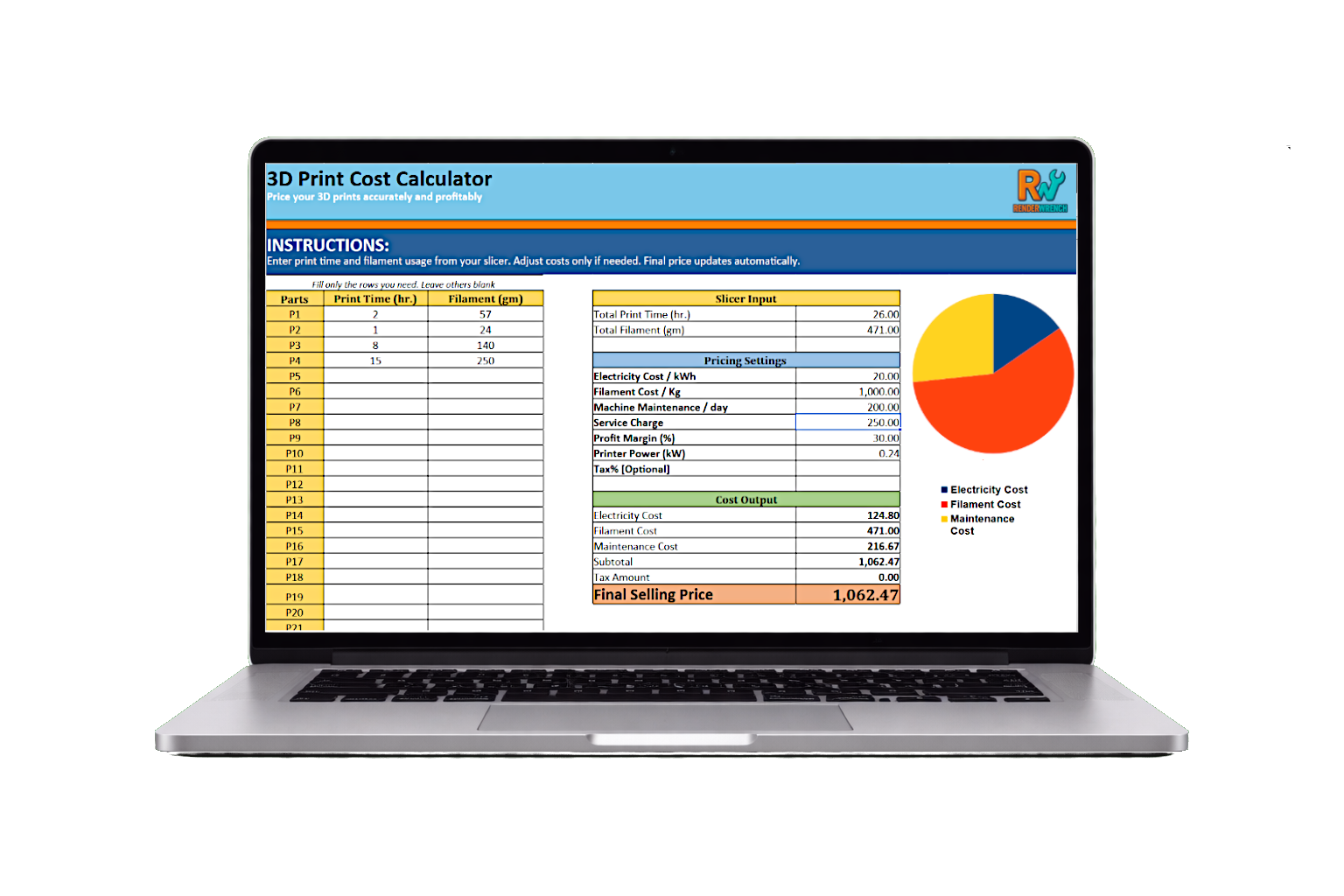
👉 Use the 3D Printing Cost Calculator here
Stop guessing.
Start pricing like a professional.
Hobby vs Business Hourly Cost — Pricing Mindset Shift
Not everyone needs the same level of calculation.
Your pricing strategy depends on why you are printing.
🛠 Hobbyist
If you’re printing for fun or personal projects, you might:
- Ignore depreciation
- Focus only on electricity
- Accept lower or zero margin
- Treat printing as a learning expense
And that’s perfectly fine.
Because your goal is experience — not profit.
💼 Small Business / Client Work
But if you’re printing for clients or selling parts, things change.
You must:
- Include machine depreciation
- Include maintenance reserve
- Account for print failures
- Protect your profit margin
Because now your printer is not a hobby tool —
It’s a revenue-generating asset.
Professional pricing requires a full hourly cost calculation.
Hobby pricing can survive on guesses.
Business pricing cannot.
That difference is what separates casual printing from sustainable income.
Why Hourly Cost Matters for Pricing
Now let’s make this practical.
Imagine you’re printing a client part that takes:
- 8 hours to print
- Your hourly operating cost = $0.50/hr
That means:
8 × 0.50 = $4 base machine cost
And that’s before adding:
- Filament
- Design time
- Post-processing
- Packaging
- Profit margin
You already have $4 in operating cost.
If you don’t properly calculate cost of 3D printing and only charge for filament, your pricing is already wrong before the print even finishes.
And here’s where it becomes serious:
- For hobby printing → small mistake
- For client work → repeated loss
If you’re running multiple printers, long-duration prints, or printing daily, failing to calculate cost of 3D printing accurately will slowly destroy your margins.
Professional 3D printing businesses don’t guess.
They calculate:
- Hourly operating cost
- Material cost
- Failure buffer
- Profit margin
If you’re unsure how to combine these factors manually, use our full 3D Printing Cost Calculator to calculate cost of 3D printing correctly and avoid undercharging.
Smart pricing = sustainable printing.
Follow RenderWrench on Instagram
To calculate cost of 3D printing per hour, add three main components:
1. Electricity cost (kWh × electricity rate).
2. Machine depreciation (printer cost ÷ expected lifespan hours).
3. Maintenance reserve ($0.05–$0.30 per hour typical).
This gives you your true hourly operating cost before adding filament or profit margin.
For most desktop FDM printers, the real cost typically ranges between $0.50 and $3 per hour.
The exact number depends on electricity rate, printer price, lifespan, and how aggressively you account for maintenance.
Not always. Many makers focus only on filament cost, but to properly calculate cost of 3D printing, you must also include electricity, depreciation, and maintenance. For long prints, machine cost can exceed material cost.