Hi makers! Let’s clear something up. One of the most common questions I get is:
How much electricity does a 3D printer use?
- Does it consume a lot of power?
- Will your electricity bill spike if you print daily?
- Is it expensive to run overnight?
Short answer?
No — but it depends on how you use it.
If you’re serious about understanding how much electricity a 3D printer uses, this guide will break it down in simple, practical terms:
- Real watt usage
- kWh consumption per hour
- Actual electricity cost
- Monthly usage examples
- And what affects power consumption the most
No myths. No guessing. Just real numbers.
How Many Watts Does a 3D Printer Use?
Most desktop FDM 3D printers consume: 120 to 350 watts while printing
But here’s the key:
That’s peak power. Actual average consumption is usually lower.
Let’s break it into phases:
🟢 Idle (Heaters Off)
- 10–20 watts
- Just electronics + screen running
🔥 Heating Phase (Highest Consumption)
- 200–350 watts
- Heated bed + hotend warming up
- Lasts 3–10 minutes
🖨️ During Printing (Stable Phase)
- 80–200 watts
- Depends on:
- Bed temperature
- Nozzle temperature
- Printer size
- Enclosure usage
So no — your printer is not constantly pulling maximum power.
⚡ How Much Electricity Does a 3D Printer Use Per Hour?
Electricity is measured in kWh (kilowatt-hours). Most desktop FDM printers consume:
0.1 to 0.3 kWh per hour
That means:
If your printer runs for 1 hour, it uses about:
- 100 to 300 watt-hours
- Or 0.1–0.3 units of electricity
That’s less than many home appliances.
💰 How Much Does It Cost Per Hour?
Let’s calculate it simply.
Electricity Cost Formula:
Power Consumption (kWh) × Electricity Rate
Example:
If your printer uses:
0.15 kWh per hour
And your electricity rate is:
$0.20 per kWh
Then:
0.15 × 0.20 = $0.03 per hour
Three cents.
That’s it.
👉 Electricity is not the biggest cost of 3D printing.
However, over long print times, it adds up.
📅 Monthly Electricity Cost Example
Let’s say you print:
- 100 hours per month
- Average 0.2 kWh per hour
Total monthly usage:
100 × 0.2 = 20 kWh
If your electricity rate is $0.20 per kWh:
20 × 0.20 = $4 per month
That’s less than many streaming subscriptions.
Even if you print heavily, electricity is usually not the financial problem.
⚠️ Stop Guessing Your 3D Printing Costs
Now you know how much electricity a 3D printer uses.
But if you’re still pricing prints based only on filament…
you’re undercharging.
Electricity is only one small piece.
The real cost includes:
- Machine depreciation
- Maintenance wear
- Failed prints
- Long print time exposure
- Hidden operating overhead
If you don’t calculate everything, you are slowly cutting into your own profit.
Professional 3D printing businesses don’t estimate.
They calculate.
That’s exactly why I built the RenderWrench 3D Print Cost Calculator.
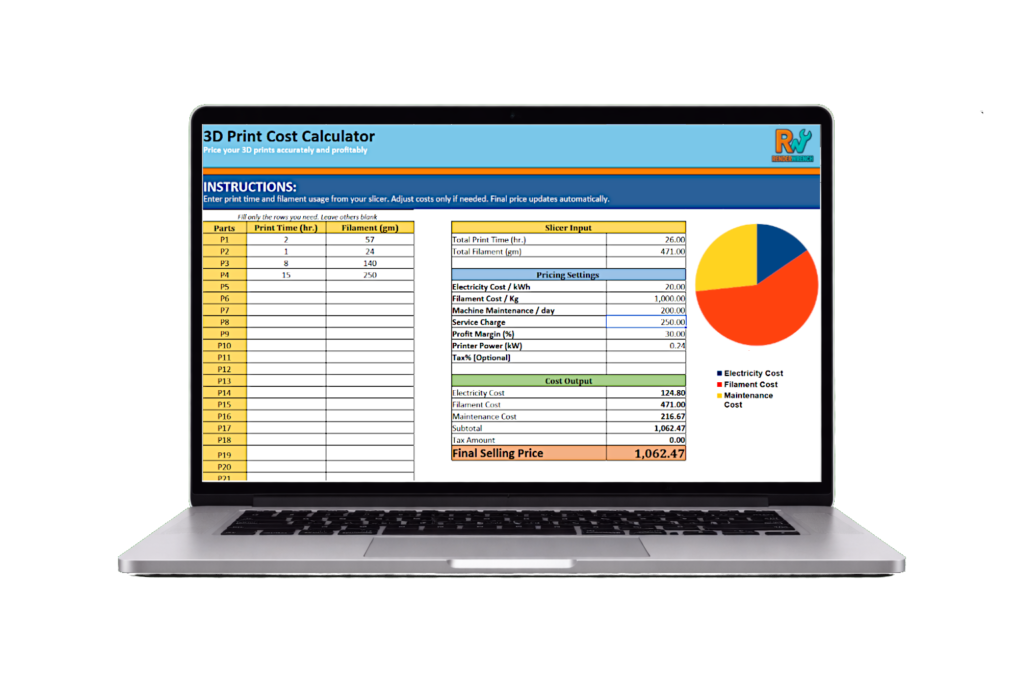
- 👉 Enter your print time.
- 👉 Enter your electricity rate.
- 👉 Enter your printer cost.
It calculates your true operating cost in seconds.
- No guessing.
- No underpricing.
- No margin leaks.
If you’re serious about making money with your printer — use the calculator.
Smart pricing builds sustainable printing.
🔥 What Increases 3D Printer Power Consumption?
Not all prints consume equal electricity.
Here’s what increases usage:
1️⃣ Heated Bed Temperature
ABS (100–110°C bed)
Consumes much more power than PLA (60°C bed)
The heated bed is the biggest power draw.
2️⃣ Long Prints
A 2-hour print vs a 20-hour print — obvious difference.
Time multiplies everything.
3️⃣ Enclosures & Chamber Heating
If you use:
- Heated enclosure
- Chamber heater
- Active temperature control
Power usage increases significantly.
4️⃣ Large Format Printers
Bigger bed
More surface area
Higher watt heater
More power consumption.
🏠 Is a 3D Printer Expensive Compared to Other Appliances?
Let’s compare average usage:
- Gaming PC → 300–600 watts
- Microwave → 1000+ watts
- Electric kettle → 1500–2000 watts
- Air conditioner → 1000–3000 watts
A 3D printer?
👉 120–350 watts.
Relatively low.
You can run a printer for hours for less electricity cost than boiling water a few times.
🧠 The Important Reality
Electricity is not what makes 3D printing expensive.
What really affects cost is:
- Machine depreciation
- Maintenance
- Failed prints
- Filament
- Your time
Electricity is just one piece of the puzzle.
If you want to see the full operating cost breakdown, check our complete guide on calculating 3D printing cost per hour.
Frequently Asked Questions
Most desktop FDM printers use between 0.1 and 0.3 kWh per hour, depending on temperature settings and printer size.
Yes — but usually only slightly. For moderate usage (100 hours/month), expect around $3–$8 depending on local rates.
The heated bed is the biggest power consumer, especially when printing high-temperature materials like ABS.
Not typically. Even a 10-hour overnight print may only cost $0.30–$1.00 in electricity depending on settings and rates.
Final Thoughts
If you’re worried about electricity cost — don’t panic. A 3D printer is relatively energy-efficient compared to most home appliances. But if you’re printing professionally, electricity is just one part of the real operating cost. Smart makers don’t guess. They understand the numbers.
And now you do too.
Follow RenderWrench on Instagram