
Hi makers! Welcome to another post of the RenderWrench Gear Series.
In the previous blogs, we learned how to design a spur gear, where to use it, and the basic gear terminology. In this post, we’ll move one step ahead and learn about compound gear trains and planetary gear systems.
Simple spur gears are good for basic power transmission. But they are not suitable for compact gearboxes, because achieving a high gear ratio makes the system large and bulky.
This is where compound gear trains and planetary gear systems come into the picture. These gear systems are still conceptually simple, yet they can transmit high torque in a very compact space. That’s why they are used in gearboxes, robots, EVs, and automatic transmissions almost everywhere.But here’s the interesting part — both systems solve the same problem in very different ways, and choosing the wrong one can completely break your design.
What is a Gear train?
For context, let me explain what a gear train is. So, gear train is a system of two or more gears meshing together to transfer motion one shaft to another shaft.
Gear trains can be used to increase torque, manipulate Speed between shaft or even change direction with same speed and torque.
(By the way… you’re a RenderWrench reader—I know you already get this 😉)
Now, let’s move on to compound gear trains.
Compound Gear train – Simple Idea, Big power
What is a Compound Gear train?
Like in my previous post, “How gears transfers motion” we show that gears transfer motion one shaft to another. But in compound gears there is two or more shaft on same shaft and they rotate together as a single unit.
In a simple gear pair only one gear ratio. But in a compound gear train, you get multiple gear ratio multiplied together. That’s where the magic happens.
Lets understand the concept with practical example.
How a compound Gear Train Works?
To understand how a compound gear train work, let’s take an example of
- Gear-A is attached to shaft-1
- Gear-A meshes with Gear-B
- Gear-B and Gear-C are mounted on the same shaft [this is the compound part of the gear train]
- Gear-C then meshes with Gear-D
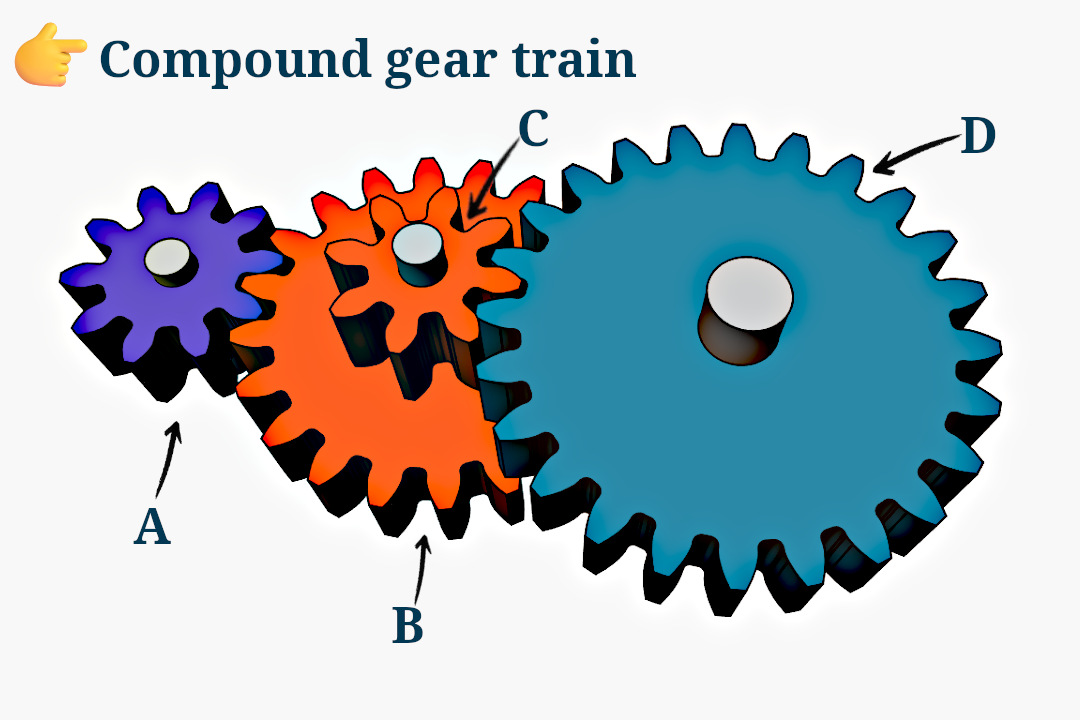
In this image above you can see a Compound gear train. Each stage reduces speed and increase torque -and those effects multiply, not add.
Speed and torque: stage-by-stage multiplication Now we understand, what is a Compound gear train is? Now the question arise, “Hey, how the Speed and torque changes in this compound Gear trains?”. To understand this let take this very example of this Gear train.
Before that lets have some considerations and some easy-pissy formulas.
🔧 Given
- Gear A = 10 teeth (input / driver)
- Gear B = 20 teeth
- Gear C = 8 teeth (mounted on the same shaft as B)
- Gear D = 24 teeth (output)
So the train works like this:
A → B (shaft 1)
C → D (shaft 2)
(B and C rotate together)
⚙️ Stage-1: Gear A → Gear B
Speed ratioSpeedB=SpeedA×TBTA=SpeedA×2010=21SpeedA
👉 Gear B rotates at half the speed of Gear A.
Torque ratioTorqueB=TorqueA×TATB=TorqueA×2
👉 Torque doubles at Gear B.
🔗 Compound effect (B & C)
- Gear B and C are rigidly connected
- So:
- Speed of C = Speed of B
- Torque of C = Torque of B
⚙️ Stage-2: Gear C → Gear D
Speed ratioSpeedD=SpeedC×TDTC=SpeedC×248=31SpeedC
Torque ratioTorqueD=TorqueC×TCTD=TorqueC×3
📉 Overall Speed Ratio (A → D)
SpeedD=SpeedA×2010×248=SpeedA×61
👉 Final speed = 1/6 of input speed
💪 Overall Torque Ratio (A → D)
TorqueD=TorqueA×2×3=6×TorqueA
👉 Final torque = 6× input torque
Why Compound Gears Matter
So far, we’ve seen how compound gear trains work and why they are such a powerful step up from simple gear pairs. By combining multiple gear stages on shared shafts, we can achieve large speed reductions and high torque multiplication without making the system excessively large.
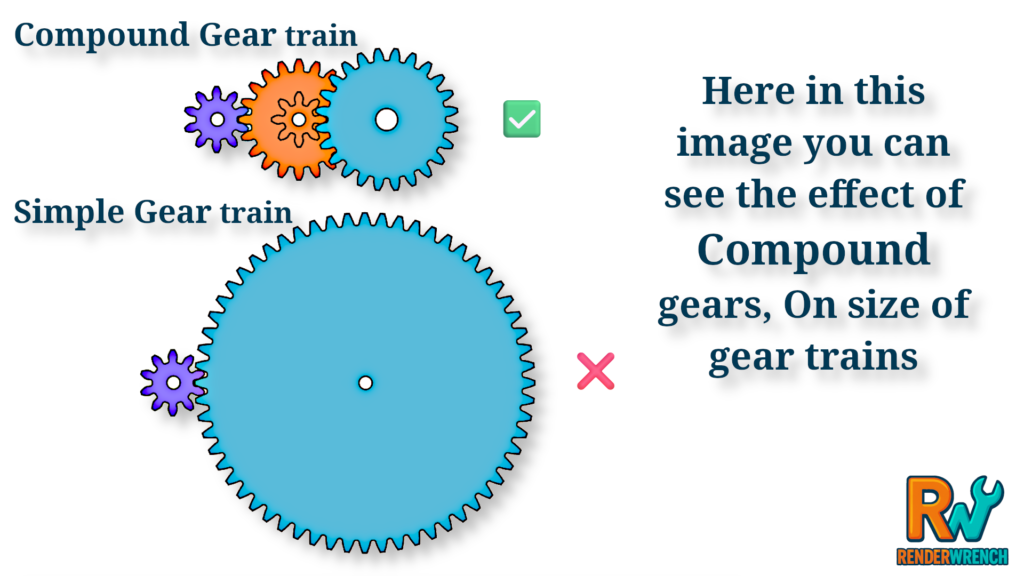
This is why compound gear trains are widely used in:
- Mechanical gearboxes
- Machine tools
- Robotics mechanisms
- Multi-stage speed reducers
But here’s the catch.
Even compound gear trains have limits.
As gearboxes become more compact and torque requirements increase, designers start facing problems like:
- Longer shaft lengths
- Higher bearing loads
- Alignment challenges
- Limited space for further gear stages
This is exactly where planetary gear systems shine.
In Part 2, we’ll explore:
- What a planetary gear system really is
- How it achieves massive torque in an extremely compact layout
- Why modern EVs, automatic transmissions, and robotic joints rely heavily on planetary gearboxes
- And most importantly — when you should choose planetary gears instead of compound gear trains
👉 Part 2 is where things get really interesting.
Bookmark this page and move on when you’re ready.
RenderWrench Insight:
Compound gear trains teach you how torque multiplies. Planetary systems teach you how engineers cheat space itself.
Happy making 🔧
Follow RenderWrench on Instagram


Pingback: Complete Gear Guide: Gears Basics to Advanced Concepts Explained Simply (RenderWrench Gear Series) - RenderWrench
Pingback: planetary gear system vs compound gear train — When and Why to Use Them | Part 2 (RenderWrench Gear Series #8) - RenderWrench